As I’ve mentioned in previous posts, the private real estate (PRE) industry—especially the office sector—was slammed by a crushing recession that began toward the end of the 1980s and extended well into the following decade. In this post, I want to share how the excesses (to put it mildly) of the savings and loan industry helped fuel the crash. I’ll also explain what the resulting downturn meant for real estate developers such as my friends at Hines—and their lawyers (such as, well, me).
The crash has long been viewed as the result of massive overbuilding of new PRE, again, especially in the office sector. For example, during the 1980s, more than 200 million square feet of new office space was delivered for occupancy each year, on average. By 1989, the U.S. office market consisted of approximately 2.5 billion square feet of space, effectively doubling the national stock in a single decade. This seems like madness in retrospect, especially today, when the future of office itself is once more up for debate.
I’ve discussed before how the Tax Reform Act of 1986 limited the deductibility of passive losses and brought the syndication business to its knees—but not before syndicators had invested vast sums of money in office development.
Then there were the savings and loan institutions, or S&Ls.
Thanks to certain regulatory changes—and the business practices that followed—S&Ls quite simply ran amok during the 1980s.
In 1980, Congress passed a law that phased out caps on the interest rates S&Ls could pay their depositors. This effectively allowed them to compete for deposits by offering ever-higher rates. The law also authorized S&Ls to make acquisition, development, and construction loans, which were far riskier, and harder to underwrite and understand, than their traditional home mortgage lending business.
These powers were further expanded in 1982, allowing S&Ls to invest up to 40%—forty percent—of their assets in private real estate and 30% in consumer loans.
Finally, the federal deposit insurance limit was abruptly raised from $40,000 to $100,000. This made it incredibly easy for “zombie” thrifts (i.e., those that were technically insolvent) to continue doing business. They could attract massive amounts of cash from yield-hungry investors who cared not a whit about the solvency of the S&L because, at the end of the day, if the thing went bust, the federal government would make those investors whole for their losses.
When it came to S&L lending to real estate developer “cowboys,” these policy changes were the functional equivalent of giving a sixteen-year-old a bottle of Jack Daniel’s whiskey and the keys to a Ford Mustang GT and sending him on his way. The result was some epic bad behavior in general and horrible lending practices in particular, especially when some of these same S&Ls fell into the clutches of the very “cowboys” who were doing the borrowing. A few examples will suffice to make the point.
(By the way, “cowboys” was indeed the term used back then to describe some of the run-and-gun developer types who did business with the S&Ls, many of which were—you guessed it—based in Texas.)

Sunbelt Savings and Loan, based in Dallas, became known in the industry as “Gunbelt Savings and Loan” thanks to the “Wild West” business style of its chairman, Edwin T. “Fast Eddie” McBirney. (Now, if you ask me, any banker whose nickname is “Fast Eddie” is a ticking time bomb waiting to blow up his bank’s balance sheet.) He was known for a high-octane lifestyle, which included a fleet of seven corporate airplanes and legendary, lavish parties (one of which reportedly featured a $5,000 spread of Russian caviar and an ice sculpture of a lion). By the time Sunbelt failed, it had become one of the most expensive bailouts of the era, due in large part to its highly speculative real estate gambles.
Vernon Savings, also based in Texas, earned the nickname “The Champagne S&L” because of the extravagant lifestyle of its owner, Don Dixon, who famously used the thrift’s funds to buy a fleet of planes (which seems to have been a popular move among these jokers) and a beachfront house in Del Mar, California, where he hosted “gastronomic tours” of Europe for his board of directors. When the regulators finally swooped in and closed Vernon Savings, they found that 96% of its loans were in default. (Dixon and his team might have done better if they’d just taken the money and gone to Vegas.)
Empire Savings and Loan, referred to sarcastically in the press as the “Temple of Thrift,” was at the center of the infamous “I-30 Scandal” in Dallas, where it financed the construction of thousands of condos that were never intended for occupancy. The scam artists involved engaged in “land flips,” selling the same piece of land back and forth among themselves to artificially inflate its price. The increasingly overvalued land could then be used as collateral to borrow ever-larger amounts of money, until the whole thing came crashing down.
All this reckless lending helped finance far more development than the market could absorb. The result was an American urban landscape awash in “see-through” buildings, so named because, with their lights on at night, you could literally see straight through floor upon empty floor to the scenery on the other side.
The downturn that followed was tough for everyone in the business, especially those, like my then-client Hines, who were basically office developers to the exclusion of all else. (As far as I know, Hines never borrowed a dime from an S&L—many of the firm’s 1980s developments actually were all equity ventures with financing provided by global institutions. But the firm still had to contend with the severe oversupply those lending practices had helped create.)
For years, there was simply no office development business to be had, and at the time many people thought it might never return. Hines kept the lights on because it had a fee-generating property management business to fall back on as well as a burgeoning business of advising banks and other financial institutions about what to do with the empty office buildings they had acquired through foreclosure.
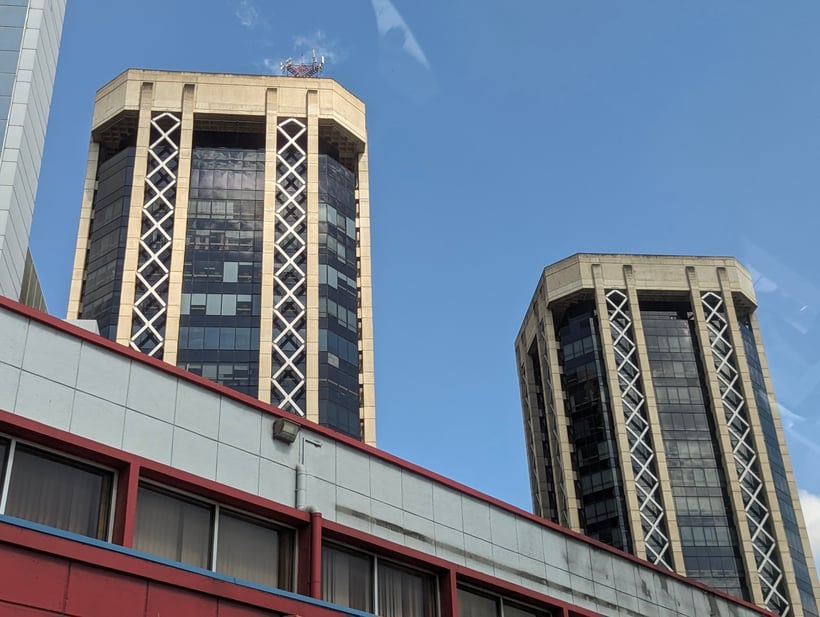
Such was the case, for example, with 1585 Broadway in New York City, a speculative (i.e., not pre-leased) office tower—the development of which had begun fairly late in the cycle, in 1989.
Right in the middle of the downturn, in the spring of 1992, my wife and I had relocated with our two sons from Houston, Texas, to New Canaan, Connecticut, so that I could then open the first New York office for Baker & Botts. We had a four-lawyer team that established a beachhead in Hines’s famous “Lipstick Building” at 53rd and Third. The local Hines team was kind enough to quickly retain me to help them negotiate a consulting agreement with the consortium of banks that, in December of the previous year, had become the reluctant new owners via foreclosure of 1585, a 42-story steel-and-glass edifice, 30 floors of which you could ‘see through.’
With Hines’s expert assistance, the banks ended up marketing and successfully selling the building to Morgan Stanley in 1993 to serve as its headquarters. (I had no way of knowing it at that time, but I would end up spending lots of time in many meetings in that building in later years, after I had left the private practice of law and joined Hines in a business role.)
This sort of odd job (i.e., representing Hines in its capacity as a consultant as opposed to an office developer) was just about the only kind of legal work involving PRE that I could scrounge up during those years. So for the duration of the downturn, I took my tax knowledge and dealmaking skills and branched out into project finance, mergers and acquisitions, and pretty much anything else I could lay my hands on. It was a tough time for a young lawyer who was trying to get a new office up and running in what even then was one of the most over-lawyered cities on the face of the planet.
But like all downward moves in PRE, this one eventually came to an end, and there was work aplenty to be had on the upswing.
In my next post, I’ll talk about some of the other consequences of that late-1980s crash, both for investors and for modes of capital formation, the follow-on effects of which continue to be felt to this day.
Accordant Investments LLC (“Accordant”) is an SEC registered investment adviser. For more information about our services and disclosures, please visit our website at www.accordantinvestments.com.
This article reflects the personal views and experiences of the author and is provided for informational purposes only and does not constitute an offer to sell, or a solicitation of an offer to buy, any product or service offered by Accordant Investments or its affiliates. Any such offer or solicitation will be made only through formal offering documents, which describe the terms, risks, and fees associated with an investment. The information contained herein should not be construed as investment advice or a recommendation to buy or sell any security. Investing involves risk, including the possible loss of principal. Past performance is not indicative of future results.
No part of this material may be (i) copied, photocopied, or duplicated in any form, by any means, or (ii) redistributed without Accordant’s prior written consent.