

Dear Valued Clients,
As we take stock of market data at the end of the first quarter, I am reminded that it’s important to consider both the short-term and long-term implications of what we see occurring in the market today.
Persistent Inflation
In the short term, the Consumer Price Index (CPI) increase of 0.4% in March, pushing the twelve-month comparison up to 3.5%, is certainly driving investors to reconsider the cost of capital. This is especially true in the near term as it now appears little relief is in sight, a significant reversal from investor sentiment just a few weeks ago. With the CPI now stalling in its path towards 2%, it is clear that the inflation problem has not gone away.
On April 16, 2024, Federal Reserve Chairman Jerome Powell said, “The recent data have clearly not given us greater confidence and instead indicate that it is likely to take longer than expected to achieve that confidence (towards 2%)”. Removing energy and its often-volatile counterpart (food) to get “core” prices does not make the inflation picture look any better. That measure also rose 0.4% in March for the third consecutive month, while the twelve-month trailing change remained at 3.8%, proving that underlying pricing pressures remain persistently high.
When looking at the key drivers of this ongoing inflation, it is easy to see how real estate is playing a key role. Over one-third of the core CPI is driven by real estate (i.e., rental inflation) both for actual apartment tenants and the imputed rental value of owner-occupied homes. Rental inflation, which we are seeing firsthand through increasing Net Operating Income (NOI) in the ODCE apartment portfolio, rose 0.4% in March and has been at or above 5% (annualized) over the trailing three-, six-, and twelve-month timeframes. Rents have been a key driver of inflation over the last year, and considering it makes up one-third of the weighting in the overall index, it’s hard to foresee a quick reversal in the CPI trend from housing.
While overall real estate values continue to adjust to the capital markets outlook, fundamentals remain exceptionally strong among virtually all areas of real estate, apart from the office sector. As shown in the chart below, NOI continues to keep pace with inflation, solidifying our long-term view that core real estate can be a hedge against the downward pressure that inflation puts on a traditional investment portfolio.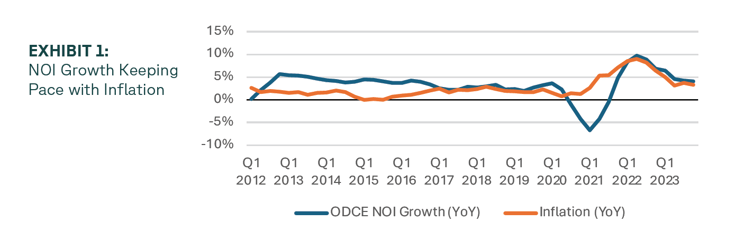 Sources: IDR, NCREIF, Bureau of Labor Statistics, as of 4Q 2023.[A1.1]
Unique Entry Point
Core real estate values have fallen for six consecutive quarters, resulting in an estimated peak-to-trough value decline of approximately -23% as of Q1 2024. For context, real estate hasn't revalued at such a pace since the Global Financial Crisis (GFC), which saw eight quarters of negative returns and a peak-to-trough decline of -44%. The revaluation period seen during the GFC was followed by a period of 40 consecutive quarters with positive returns in the NFI-ODCE Index.
This leads us to believe that there will be an exceedingly rare occasion to enter the market at favorable pricing as some of the best quality real estate in the country is trading at a considerable discount from previous highs (an opportunity that only occurs every 15 years on average). In fact, in many cases, an investor can buy a building today for less than it would cost to build that same building (i.e., below replacement cost); an investment strategy that has historically been successfully employed by some of the world’s most sophisticated real estate investors. This phenomenon arguably hasn’t happened since the GFC. At a minimum, history is on our side, and at best, the coming year could represent a generational buying opportunity for prudent investors who add core real estate to their asset allocation.
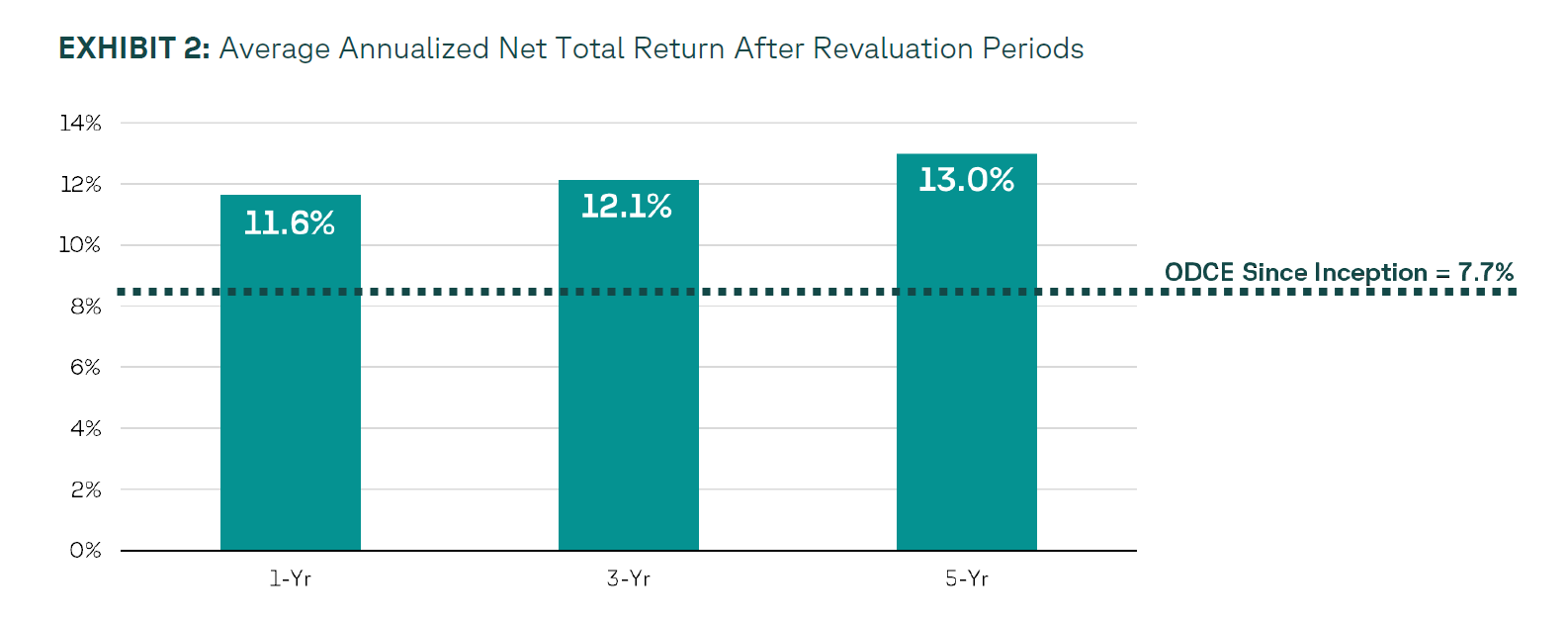
Investors who stay in the market during these periods of revaluation, or enter before the recovery has taken off, in our view, may potentially be rewarded for their decision. As shown below, the NFI-ODCE Index has produced attractive returns following periods of revaluation.
 Summary
As we have consistently discussed, those of you who are already fully allocated to real estate can rest well knowing the sector is performing as expected and has exceptionally strong operating fundamentals. For others who may have seen a recovery in public equities and are now under-allocated to private real estate, we would encourage you to seize the moment because market conditions can change quickly. For instance, during the GFC, the NFI-ODCE went from having an exit queue equivalent to 15% of the index’s value to having an entry queue that was 12% of the index’s value in only a matter of two quarters – leaving many would-be investors without real estate exposure during the initial stages of the recovery.
On behalf of the team at Accordant, we look forward to engaging with you in 2024 as the real estate market continues to evolve.
Garrett Zdolshek
Chief Investment Officer and Portfolio Manager
garrett.zdolshek@accordantinvestments.com
accordantinvestments.com
Data Sources
IDR, NCREIF as of 4Q 2023, Bureau of Labor Statistics as of 1Q 2024.
Important Disclosures
Accordant Investments LLC (“Accordant”) is an SEC registered investment adviser. This presentation does not constitute an offer to sell, a solicitation of an offer to buy, or a recommendation of any security or any other product or service managed by Accordant. Past performance is no guarantee of future results. Indexes are unmanaged, do not incur management fees, costs, and expenses, and cannot be invested in directly. Diversification strategies do not ensure a profit and do not protect against losses in declining markets. The selected examples of specific types of investments were selected for illustrative purposes only and are not necessarily representative of all transactions of a given type with regard to performance and/or operating metrics.
This market update contains forward-looking statements which include statements, express or implied, regarding current expectations, estimates, projections, opinions, and beliefs of Accordant. Such statements are forward-looking in nature and involve a number of known and unknown risks, uncertainties and other factors. Accordant’s opinions may change, and actual results may differ materially from the forward-looking statements.
Certain information contained in here has been obtained from third-party sources. While taken from sources believed to be reliable, Accordant has not independently verified such information and makes no representations about the accuracy of the information or its appropriateness for a given situation. In addition, this content may include third-party advertisements; Accordant has not reviewed such advertisements and does not endorse any advertising content contained therein. Charts and graphs provided within are for informational purposes solely and should not be relied upon when making any investment decision.
No part of this material may be (i) copied, photocopied, or duplicated in any form, by any means, or (ii) redistributed without Accordant’s prior written consent.
Past Performance is No Guarantee of Future Results.
Investing in the Fund involves risks, including the risk that you may receive little or no return on your investment or that you may lose part or all your investment. The Fund’s investment objective is to employ an indexing investment approach that seeks to track the NCREIF Fund Index – Open End Diversified Core Equity (the “NFI- ODCE Index”) on a net-of-fee basis while minimizing tracking error. There can be no assurance that the actual allocations will be effective in achieving the Fund’s investment objective or delivering positive returns. It is not possible to invest in an index. You cannot invest directly in an index and unmanaged indices do not reflect fees, expenses, or sales charges.
The ability of the Fund to achieve its investment objective depends, in part, on the ability of the Advisor to allocate effectively the Fund’s assets across the various asset classes in which it invests and to select investments in each such asset class. There can be no assurance that the actual allocations will be effective in achieving the Fund’s investment objective or delivering positive returns. Limited liquidity is provided to shareholders only through the Fund’s quarterly repurchase offers for no less than 5% of the Fund’s shares outstanding at net asset value. There is no guarantee that shareholders will be able to sell all the shares they desire in a quarterly repurchase offer.
An investment in the Fund represents an indirect investment in the securities owned by the Fund. The value of these securities, like other market investments, may move up or down, sometimes rapidly and unpredictably. The Fund is classified as a “non-diversified” under the Investment Company Act of 1940 and therefore may invest more than 5% of its total assets in the securities of one or more issuers. As such, changes in the financial condition or market value of a single issuer may cause a greater fluctuation in the Fund’s net asset value than in a “diversified” fund. The Fund is not intended to be a complete investment program.
The Fund is subject to the risk that geopolitical and other similar events will disrupt the economy on a national or global level. For instance, war, terrorism, market manipulation, government defaults, government shutdowns, political changes or diplomatic developments, public health emergencies (such as the spread of infectious diseases, pandemics, and epidemics) and natural/environmental disasters can all negatively impact the securities markets.
Pandemics and other similar worldwide events may have potential impacts on the real estate market may include lower occupancy rates, decreased lease payments, defaults and foreclosures, among other consequences. It is not known how long such impacts, or any future impacts of other significant events described above, will or would last, but there could be a prolonged period of global economic slowdown.
The Fund will concentrate its investments in real estate industry securities. The value of the Fund’s shares will be affected by factors affecting the value of real estate and the earnings of companies engaged in the real estate industry. These factors include, among others: (i) changes in general economic and market conditions; (ii)changes in the value of real estate properties; (iii) risks related to local economic conditions, overbuilding and increased competition; (iv) increases in property taxes and operating expenses; (v) changes in zoning laws; (vi) casualty and condemnation losses; (vii) variations in rental income, neighborhood values or the appeal of property to tenants; (viii) the availability of financing; (ix) climate change; and (x) changes in interest rates. Many real estate companies utilize leverage, which increases investment risk and could adversely affect a company’s operations and market value in periods of rising interest rates. The value of securities of companies in the real estate industry may go through cycles of relative under-performance and over-performance in comparison to equity securities markets in general.
Additional risks related to an investment in the Fund are set forth in the “Risks” section of the prospectus, which include, but are not limited to the following: correlation risk; credit risk; fixed income risk; leverage risk; and risk of competition between underlying funds.
Investors should carefully consider the investment objectives, risks, charges, and expenses of the Accordant ODCE Index Fund. This and other important information about the Fund are contained in the prospectus, which can be obtained online at accordantinvestments.com. The prospectus should be read carefully before investing. Investors should consult with their selling agents about the sales load and any additional fees or charges their selling agents might impose on each class of shares.
The Accordant ODCE Index Fund is distributed by ALPS Distributors, Inc (ALPS). Accordant Investments LLC is not affiliated with ALPS.