

Private Real Estate in a Shifting Investment Regime
In March 2025, we outlined our view that a new investment regime had begun—defined by lower expected public market returns, interest rate and inflationary uncertainty, and increased volatility. As we move through 2026, our conviction in these views has only strengthened, supported by the data and market trends we have observed. These same concerns were consistently echoed by allocators at our Third Annual Accordant Allocator Roundtable, where they emerged as a key driver behind the continued shift toward private real estate.
Further, we continue to believe the real estate market recovery is underway, although we expect it to unfold unevenly across property types, geographies, and capital structures.
The private real estate market, as measured by the leading benchmark, the NFI-ODCE Index, has rebalanced its sector and asset exposures over the past year, and we believe it is now well positioned to drive returns going forward. The office sector, in particular, has decreased as a component of the index by over 1% during that period, while the higher-growth industrial and residential sectors are now more than 65% of the Index. Including alternative sectors brings that exposure to over 70%.
Just as importantly, given the broadly diversified Index, minimal life sciences exposure has been added to the portfolio amid the headwinds in office and life sciences. While challenges within these sectors may persist for some time, the exposure within the Index remains limited and the portfolio’s constraints on the use of debt financing reduce the likelihood that managers will be forced to sell under pressure, thus freeing managers to hold assets through the cycle and maximize value.
An Uneven Private Real Estate Market Recovery
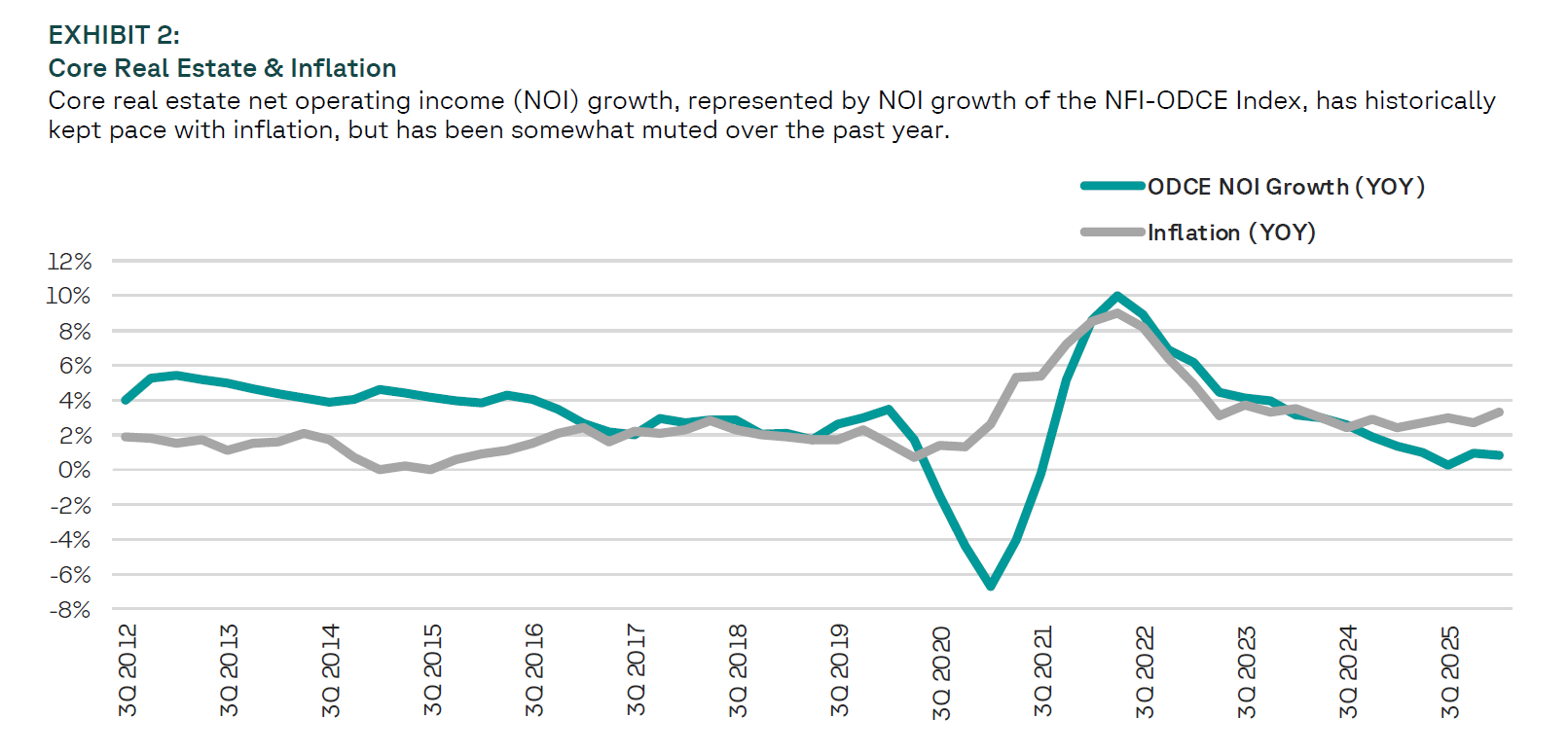
The private real estate market appears to be approaching an important inflection point. Valuations have largely stabilized, liquidity conditions are gradually improving, and the NFI-ODCE Index has now produced seven consecutive quarters of positive returns following what was likely the market trough in Q2 2024. 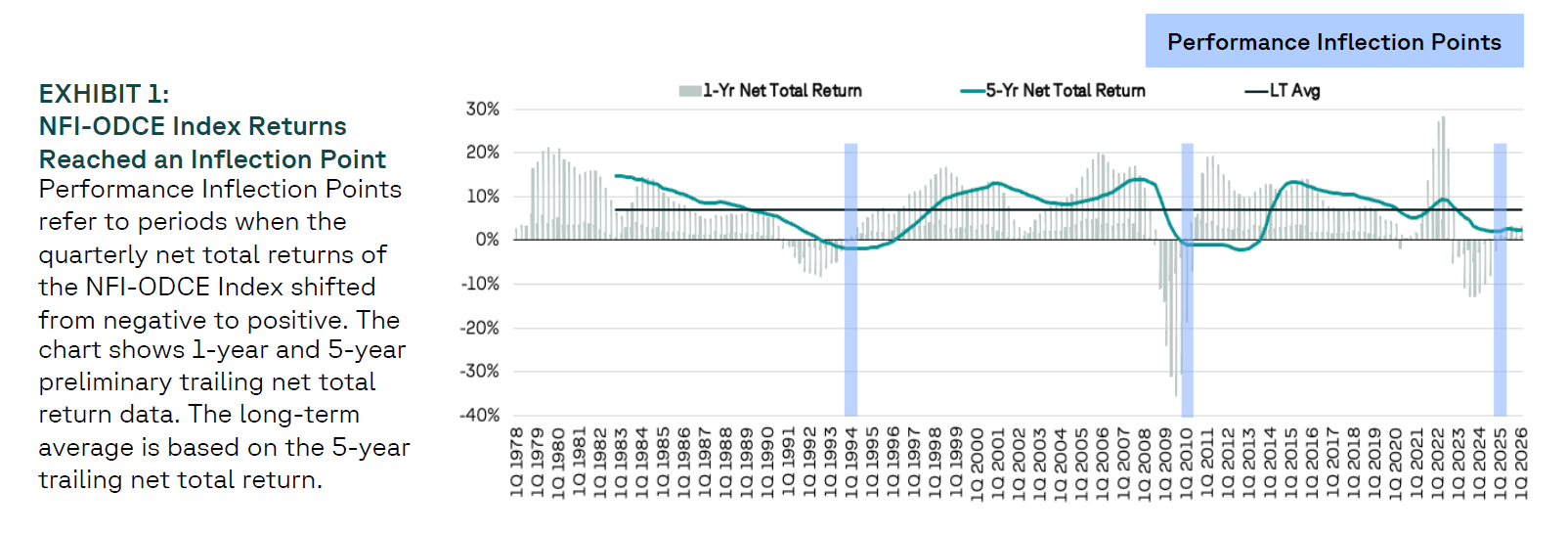 Yet while returns remained positive in Q1 2026, they were again somewhat tempered due to lower NOI Growth (YOY) compared to inflation (YOY).
 Fundamentals Matter
Simply put, private real estate is a demand-driven asset class. As long as tenant demand remains stable and supply stays constrained, fundamentals should support continued recovery. However, given low interest rates from the past cycle and COVID-driven demand for industrial and residential space, new supply has been robust. It will take some time for demand to catch up, but momentum is clearly accelerating. With increased demand coupled with limited new supply coming to market over the next few years, there is a compelling case for stronger NOI growth ahead.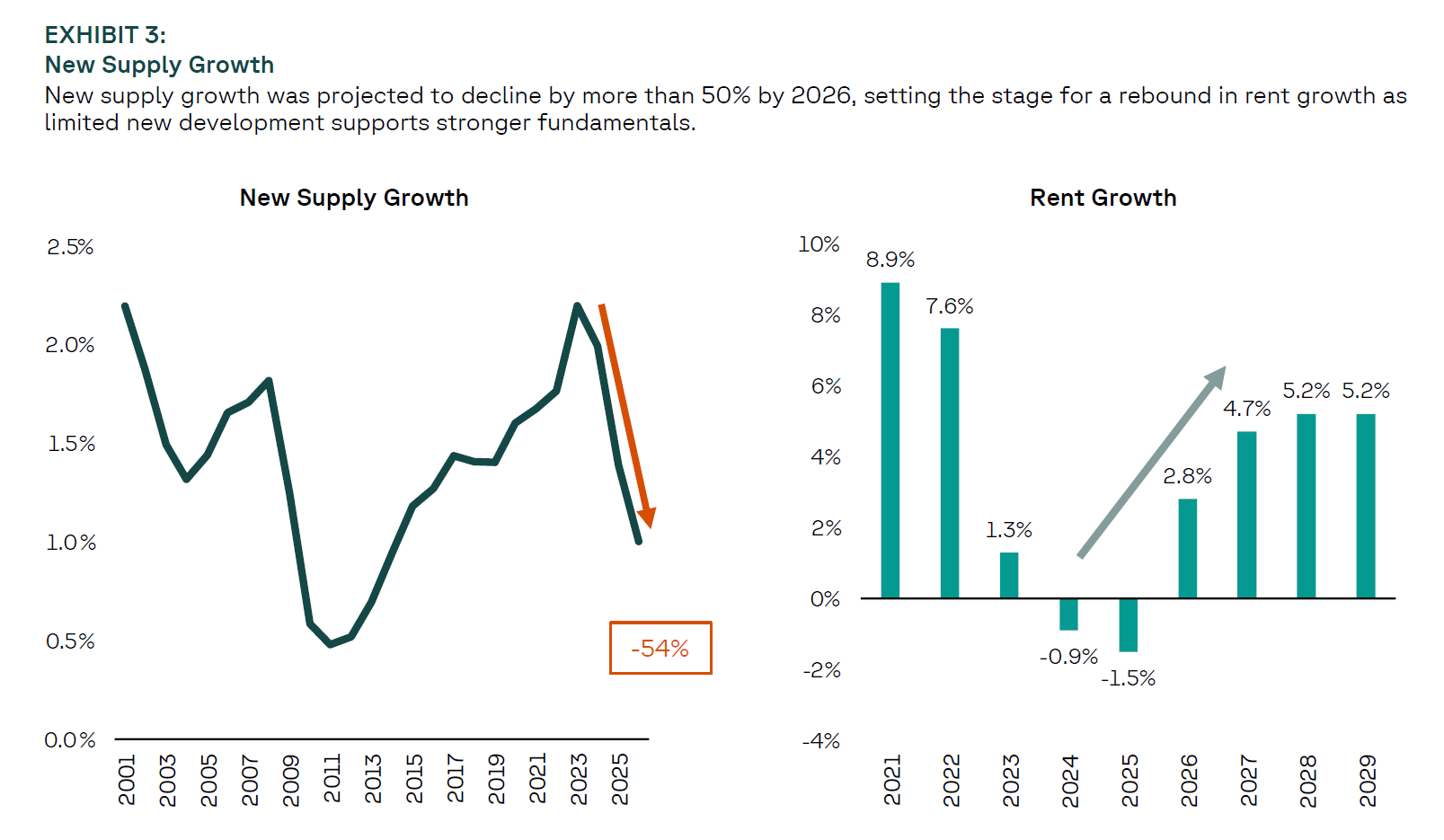
Replacement Cost
In today's market, fundamentals remain solid, and one could argue they are poised to improve as higher construction costs driven by tariffs and inflation are likely to constrain new supply going forward.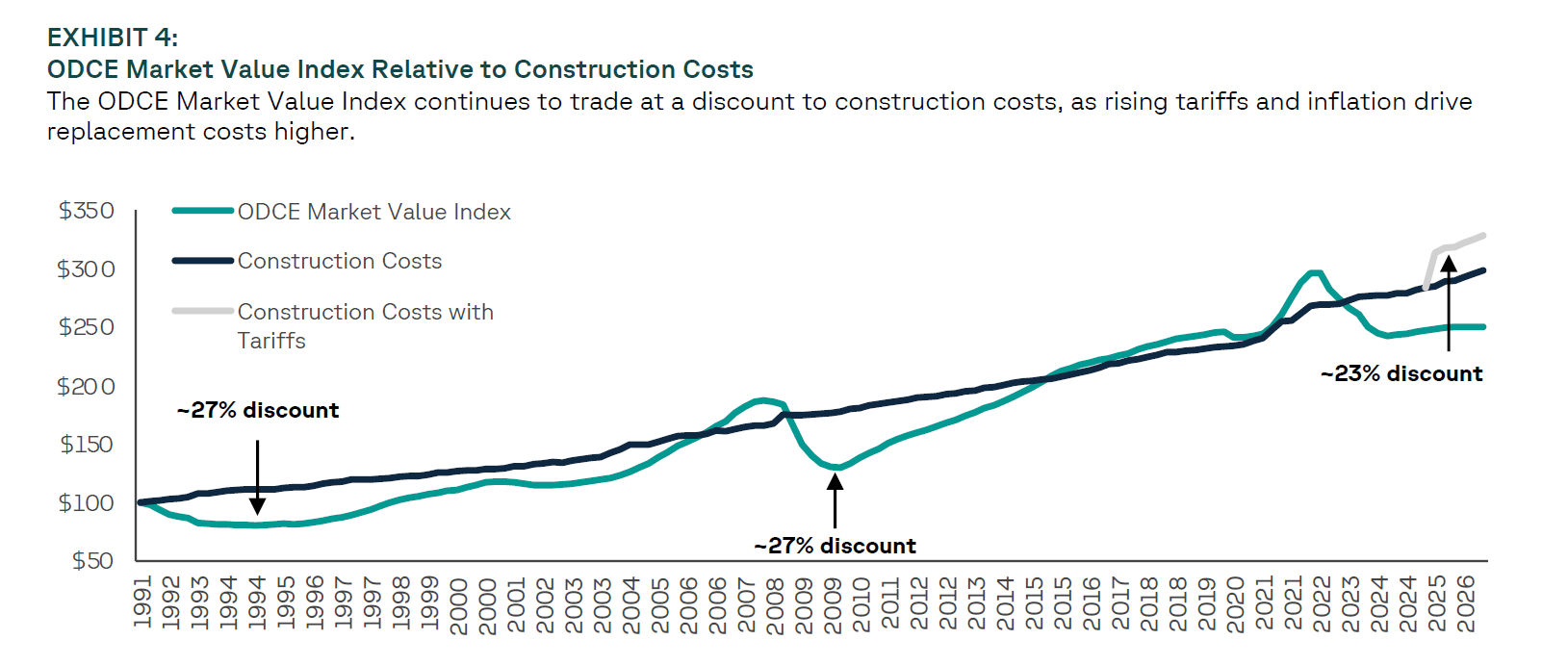
Mitigate Asset Allocation Risk and Diversify
High-quality private real estate plays a valuable role in portfolio strategy today. It offers several attractive attributes, including the potential to hedge inflation and enhance portfolio diversification. Historically, private real estate has exhibited a low correlation to traditional asset classes such as public equities and fixed income. In short, when stocks and bonds zig, private real estate tends to zag—providing diversification benefits that help reduce overall portfolio risk.
Maintaining a consistent target allocation to the asset class is important for many investors today, as it can serve as a safeguard during challenging economic conditions. However, as noted, the private real estate recovery is expected to remain uneven—not all sectors or assets will have the same outcome—making diversification within private real estate important.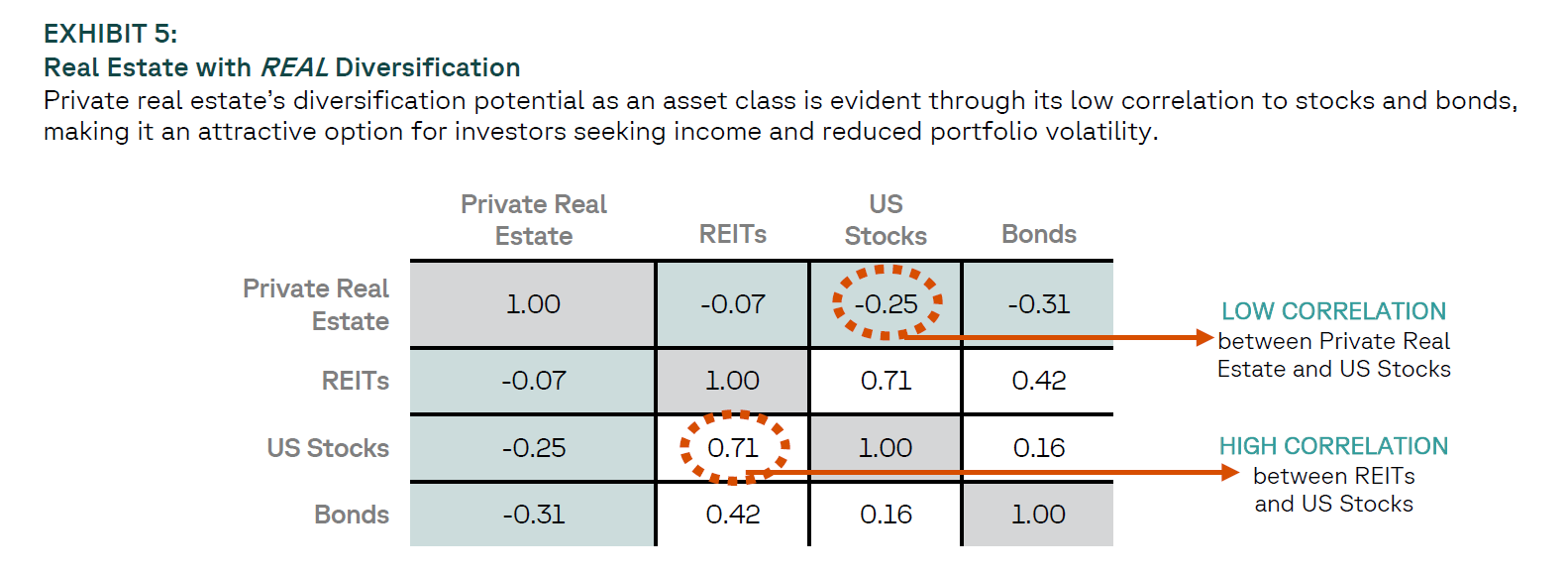
Selectively Seize Opportunity
Some investors will opt to sit tight amid ongoing market uncertainty, particularly those who are unsure of how to navigate these conditions. Yet, history suggests that periods of uncertainty and volatility tend to create attractive opportunities. Our approach is to be selective as these opportunities emerge, leveraging our private real estate expertise and experience through prior cycles to identify and capitalize on them effectively. In this environment, we remain confident that high-quality, conservatively leveraged real estate—especially core assets that have already been repriced—is at an attractive basis relative to other asset classes today.
Conclusion
Looking ahead, there will always be risks that investors must navigate as the world around them changes. At Accordant Investments, our focus remains fixed on the same long-term themes that drive our strategy.
Private real estate remains one of the most stable asset classes during periods of market turbulence. While public equity markets tend to be relatively more prone to volatility, private real estate offers valuable diversification for investors who recognize the value of tangible, income-generating assets that provide low-correlated returns to stocks and bonds.
For those who are fully allocated to private real estate, we believe there is reason for continued confidence in the sector’s resilience and growth potential. For those who have yet to optimize their allocations, this may be an opportune time to reconsider their position. Whether focusing on high-quality core assets or newly emerging opportunities, such as those that capitalize on investing in assets below replacement cost or on the demand for tech-related real estate, we believe there are compelling reasons to act now.
On behalf of our team at Accordant Investments, we want to thank you for your continued trust during these challenging yet promising times. We remain committed to delivering transparent, high-quality solutions that align with your investment goals.
Garrett Zdolshek
Chief Investment Officer and Portfolio Manager
garrett.zdolshek@accordantinvestments.com
accordantinvestments.com
Sources
EXHIBIT 1: 1-Yr & 5-Yr preliminary trailing net total return data as of Q1 2026. Long-term average based on the 5-Yr trailing net total return. Performance Inflection Points refer to periods where quarterly net total returns of the NFI-ODCE Index shifted from negative to positive. Source: IDR, Component Funds, NFI-ODCE Index (“ODCE”).
EXHIBIT 2: Year-over-year same-store NOI growth for the NFI-ODCE Index as of Q1 2026. Year-over-year inflation represented by the Consumer Price Index for All Urban Consumers: All Items in U.S. City Average as of Q1 2026. Source: IDR, NFI-ODCE, U.S. Bureau of Labor Statistics.
EXHIBIT 3: Data as of Q4 2025. Source: IDR, Green Street, DWS, NCREIF.
EXHIBIT 4: Data as of Q1 2026. Source: IDR, NCREIF, ENR.
EXHIBIT 5: Fifteen-year correlation of total gross returns for all asset classes as of Q1 2026. Past performance is not indicative of future results. All indices are unmanaged and not directly investable. Source: NFI-ODCE Index (“Private Real Estate”), FTSE Nareit Equity (“REITs”), S&P 500 (“U.S. Stocks”), Bloomberg Barclays U.S. Aggregate Bond Index (“Bonds”).
Important Disclosures
Accordant Investments LLC (“Accordant”) is an SEC registered investment adviser. For more information about our services and disclosures, please visit our website at www.accordantinvestments.com. This content does not constitute an offer to sell, a solicitation of an offer to buy, or a recommendation of any security or any other product or service managed by Accordant.
NCREIF Fund Index – Open End Diversified Core Equity (the “NFI-ODCE Index”). Indexes are unmanaged, do not incur management fees, costs, and expenses, and cannot be invested in directly. Diversification strategies do not ensure a profit and do not protect against losses in declining markets. The selected examples of specific types of investments were selected for illustrative purposes only and are not necessarily representative of all transactions of a given type with regard to performance and/or operating metrics.
Past performance is no guarantee of future results. Therefore, you should not assume that the future performance of any specific investment or investment strategy will be profitable or equal to corresponding past performance levels. Inherent in any investment is the potential for loss. It should not be assumed that any investments in securities, companies, sectors, or markets identified and described in this were or will be profitable.
This content is provided for informational purposes only, and should not be relied upon as legal, business, investment, or tax advice. Furthermore, this content is not directed at nor intended for use by any investors or prospective investors and may not under any circumstances be relied upon when making a decision to invest in any strategy managed by Accordant.
This market update contains forward-looking statements which include statements, express or implied, regarding current expectations, estimates, projections, opinions, and beliefs of Accordant. Such statements are forward-looking in nature and involve a number of known and unknown risks, uncertainties and other factors. Accordant’s opinions may change, and actual results may differ materially from the forward-looking statements.
Certain information contained in here has been obtained from third-party sources. While taken from sources believed to be reliable, Accordant has not independently verified such information and makes no representations about the accuracy of the information or its appropriateness for a given situation. In addition, this content may include third-party advertisements; Accordant has not reviewed such advertisements and does not endorse any advertising content contained therein. Charts and graphs provided within are for informational purposes solely and should not be relied upon when making any investment decision.
No part of this material may be (i) copied, photocopied, or duplicated in any form, by any means, or (ii) redistributed without Accordant’s prior written consent