

Revisiting the New Investment Regime
In March 2025, Accordant held its annual Allocator’s Real Estate Roundtable in Scottsdale, AZ, and it's remarkable how much has changed over the last 60 days. During the conference, we discussed our belief that a new investment regime had begun, driven primarily by the following key factors:
The U.S. stock market was strongly overvalued heading into 2025. The Price-to-Earnings (P/E) Ratio, which measures the market's price relative to its earnings, was significantly above historical averages. In fact, by the end of 2024, the ratio reached levels only seen twice over the last 150 years – during the post-pandemic recovery in 2021 and the tech bubble in 1999-2000. In each of those previous occurrences, a meaningful correction followed, so it would have been foolhardy to rule out a similar outcome at the time.
Uncertainty around the Economy, Interest Rates and Inflation
While the data did not yet justify calling a recession at the start of the year, there were signs of a slowing economic outlook as cracks were beginning to form across consumer balance sheets. For example, credit card delinquencies surged in Q4 2024, rising to the highest level since 2011.1 This dynamic was notable as strong consumer spending had powered the economy in recent years, and such a drastic shift seemed to herald weaker economic growth going forward.
Meanwhile, inflation had been slowing significantly from all-time highs just a few years ago, but remained stubbornly elevated in recent quarters, hovering above the Federal Reserve’s 2% target. Even as early as February of this year, concerns about higher prices were bolstered by data from the Michigan Consumer Survey, which estimated 5-year inflation expectations at 3.30%, marking the highest such figure since 2008. Given this backdrop, market commentators voiced increasing concern that the inflationary environment might persist and prompt the Federal Reserve to keep interest rates higher for longer.
Market Volatility
Suffice it to say that, while we were directionally correct in our assessment, much of the above outlook was unfortunately verified on April 2, where the average U.S. tariff rate rose to ~19%, representing the highest level since the Great Depression Era of the 1930s. While the possibility of tariffs being increased to such an eye-watering level was not given heavy weight in our initial thought process, we believe our overall economic outlook largely remains intact.
The subsequent several shifts in trade policy have not only sparked widespread uncertainty and volatility, but they have also caused many market participants to pause some investment activity. In fact, at a large industry conference, which we attended with more than 50 of the world’s largest institutional real estate investors, the consensus was that it would be prudent to take a “wait and see” approach until there is more clarity regarding the actual implementation and corresponding impact of tariffs. We would also note that these investors have significant allocations to private real estate and were largely positive on their current holdings, and in no hurry to begin selling as these assets serve a valuable role in their multi-asset portfolio.
Market Realities vs. Expectations
At the beginning of the year, private real estate markets were clearly in recovery mode. For starters, valuations had adjusted to reflect current interest rates, and at the time, we had written in our quarterly market commentary that we believed the ODCE index had bottomed. We projected that the rolling 1-year return would turn positive in Q1 2025 for the first time in 2 years, which it has. Construction costs, which had increased rapidly in recent years due to elevated inflation and a tight labor market, were finally showing signs of moderating. Supply levels, or new development starts, were fairly limited apart from a few pockets of overbuilding. Overall, the supply/demand fundamentals were strong, transaction activity was relatively healthy, and deal flow was increasing by the week. Plus, there was a general view amongst market participants that interest rates would ease further, further propelling the private real estate recovery. Thus, going into 2025, we believed that forward returns for real estate were set to deliver an outcome that was at or above historical norms.
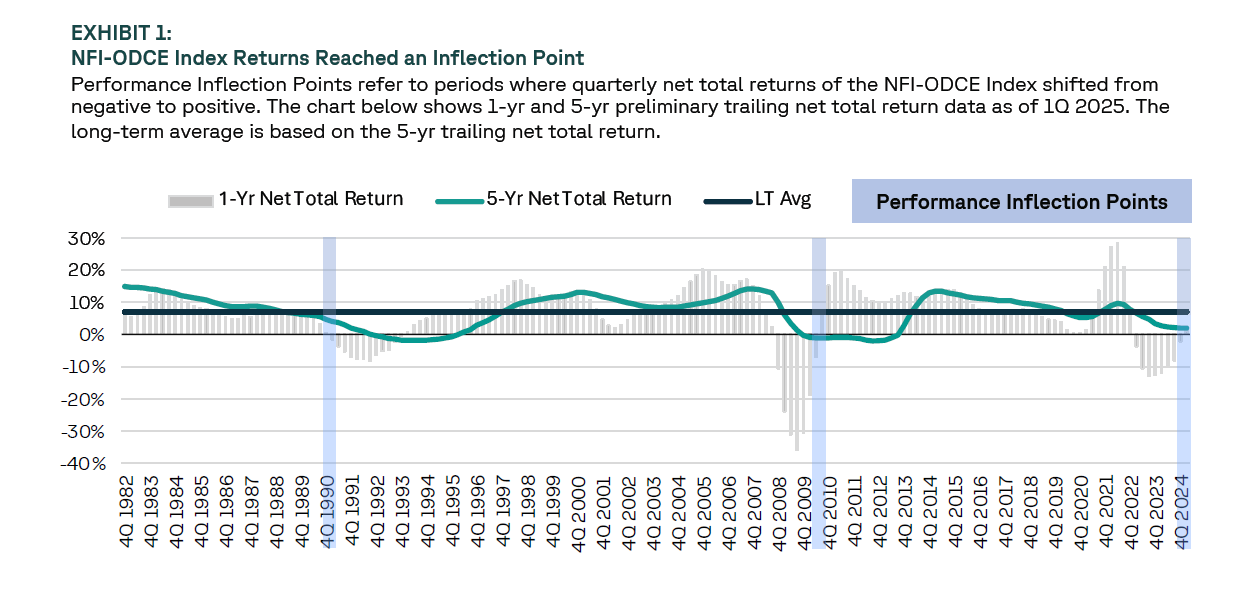
Of course, all these conditions existed prior to the series of U.S. tariff announcements in April. Certainly, since then, market sentiment has shifted. In fact, according to the Bank of America Global Fund Manager Survey, bearish sentiment is currently at its highest point in decades.2 While the concerns are warranted, it’s important to remember that the final outcome around the Administration’s trade policy is still to be determined, both for the macro economy and the private real estate market at large. Plus, given the many variables at play, any in-depth analysis is akin to solving an “if/then” equation, while having limited and very imperfect data. Still, we believe it’s important to evaluate these issues through the lens of asking how this will impact private real estate. So it is from this perspective that we share our view and some of the potential outcomes that we can envision ahead.
Tariff-Driven Considerations for Private Real Estate
There are multiple tariff-driven scenarios (if/then) and a wide range of outcomes that could significantly impact private real estate in both the short and long term. Therefore, we’ll focus on several key issues while underscoring the vast complexities (and seeming contradictions) that could shape the private real estate market as the tariff outlook unfolds:
Re-evaluating Inflation Expectations
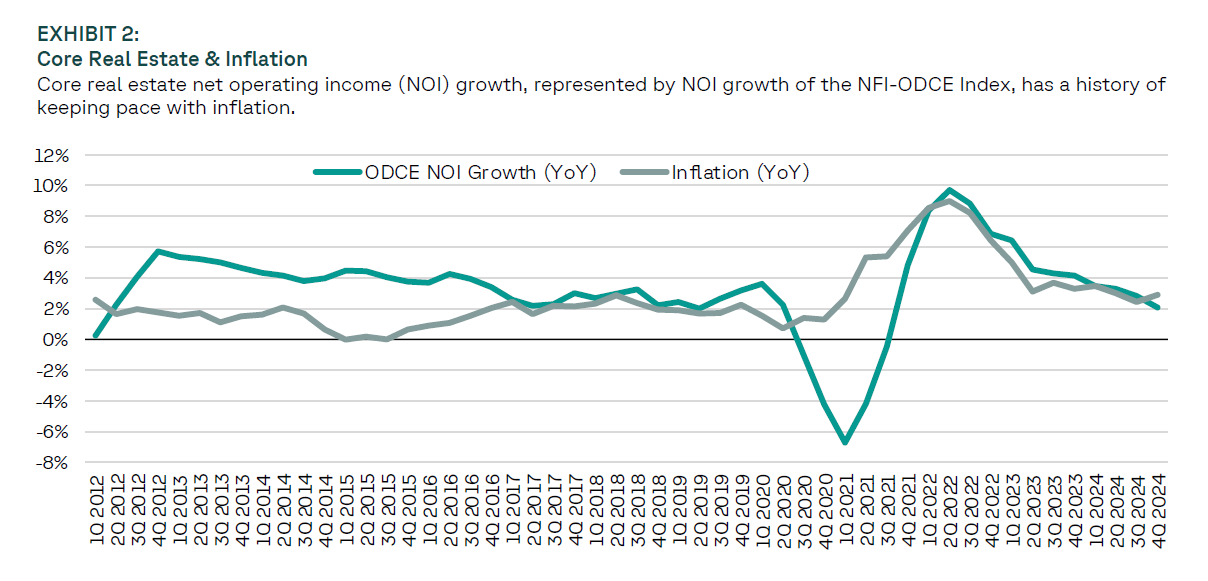
One of the major concerns of a higher tariff environment is its potential to cause inflation. Inflation impacts private real estate returns in a number of ways. For example, it generally leads to an increase in property values as replacement costs rise and it can also spur rental growth as landlords adjust rents to keep pace with rising costs, which can help maintain or increase cash flow from properties. Conversely, high inflation can increase operating costs and thereby cause an erosion in net income, particularly if rents fail to increase proportionately. Yet, higher inflation also tends to attract investors to private real estate as a hedge given the asset class's ability to generate income and appreciate in value during inflationary periods. All this is to say, the relationship between inflation and private real estate is complex even during somewhat normal market conditions, and one would expect even greater uncertainty in the current tariff-driven environment.
Counting the Construction Costs
As noted above, inflation tends to lead to higher replacement costs, largely due to increases in construction budgets. In fact, tariffs on steel and aluminum, which are primary components for real estate developments, recently rose to ~25%.3 If these tariff levels remain in place, they could certainly lead to higher project costs and potentially lower profit margins. Thus, in the near term, many new construction opportunities may no longer “pencil out” given the higher cost of construction materials. As a result, one would expect there to be less new real estate supply, which should ultimately benefit existing real estate portfolios. This is important because in an environment where there is limited new supply, real estate investors have historically been able to sustain healthy rental growth. It is not clear if this will be the case under the whatever tariff regime ultimately obtains, but it certainly falls within the realm of potential outcomes.
Higher for Longer Interest Rates
Inflation often leads to higher interest rates. The resulting increased cost of borrowing can impact the profitability of leveraged investments like some strategies in private real estate, reducing overall returns. This exact scenario played out in recent years across the private real estate market, when interest rates rose 425 basis points from March to December 2022, the fastest pace of tightening since the early 1980s.4 During that period, the private real estate market effectively froze. Deal volume fell dramatically, liquidity all but disappeared, and many investors withdrew from the market for nearly two years until conditions eased. This market disruption occurred in large part because of the uncertainty surrounding the pace of changes in interest rates, which, of course, was directly a result of persistently elevated inflation. Therefore, while inflation tends to result in several positive outcomes for real estate, these can be overshadowed should interest rates rise rapidly or remain at elevated levels for extended periods.
On the other hand, private real estate that has low leverage, such as that in the NFI-ODCE Index, has already been revalued by 25% and has higher cash flow with low leverage. The combination of high-quality assets that have a lower basis than replacement cost makes the NFI-ODCE Index a compelling alternative. Plus, over the long term, these assets will likely benefit from stability and current cash flows.
Slow-Growth Economic Outlook
Economists are generally bearish on the short-term macro effects of higher tariffs, with industry leaders like JP Morgan predicting a 60% chance of a recession in 2025.5 As one would expect, slower economic growth is certainly a drag on the broader private real estate market. Yet, even in this downside scenario, there will be some pockets of optimism. For example, should a recession occur, it would likely lead to a deflationary environment, finally breaking the inflationary trend that has gripped the economy for years. One would also expect the Federal Reserve to cut interest rates in response, which would benefit private real estate by reducing financing costs and bringing cap rate spreads (the cost of debt vs. expected yield) closer to historical norms. By no means are we saying that a recession is good news for private real estate, because history shows that tenant demand declines during such periods. However, there are aspects of a slow-growth environment that could help reset the private real estate market and accelerate its recovery due to longer term leases and limited new supply.
Navigating Uncertainty and Volatility
The conditions that have emerged from the seemingly daily headlines (not all of them consistent) around the current Administration’s proposed tariff policy are causing investors to rethink their priorities for the remainder of the year. As noted above, it’s difficult at this stage to predict with any level of certainty what outcome will emerge, and this lack of clarity will likely lead to increased market volatility. So, what is an investor to do? In our view, it is important to keep in mind the following:
Focus on the Fundamentals
In its simplest form, private real estate is intended to meet the needs of tenant-driven demand. Historically speaking, so long as the supply/demand dynamic maintains a healthy equilibrium, investors have done well over the long term. In today's market, the fundamentals are solid, and one could argue they are poised to improve should tariffs result in higher construction costs that limit new supply from coming online in the near term.
Mitigate Asset Allocation Risk and Diversify
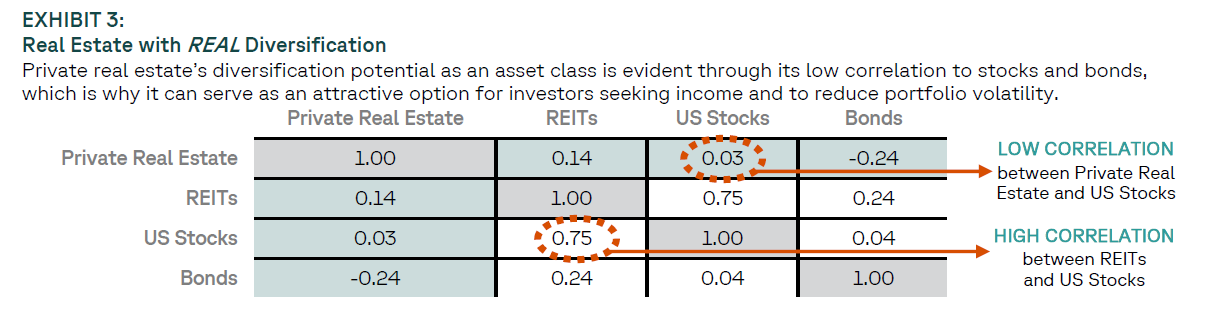
Private real estate plays a meaningfully valuable role in a portfolio today. Private real estate has several attractive attributes, including its ability to offer a hedge against inflation while also providing portfolio diversification. Private real estate has historically exhibited a low correlation to traditional asset classes like public equities and fixed income. In short, when stocks and bonds zig, private real estate tends to zag, providing diversification benefits that reduce overall portfolio risk. Thus, maintaining their customary target asset allocation is crucial for many investors today because it serves as a safeguard during challenging economic conditions.
Selectively Seize Opportunity
Understandably, some investors will opt to sit tight in the face of pending market uncertainty, particularly those who are unsure how to navigate those conditions. Yet, history suggests that uncertainty and volatility tend to create attractive opportunities. Our approach is to be selective as these opportunities emerge, leveraging our private real estate expertise and experience from prior cycles to take advantage of such opportunities as they present themselves.
Conclusion
Looking ahead, there are always risks that investors must navigate as the world around them changes. At Accordant, you will continue to hear the same key themes that drive our focus over the long term.
Private real estate remains one of the most stable sectors during turbulent times. While the public equity markets will always be relatively more prone to fluctuation, private real estate offers a much-needed diversification tool for investors who recognize the value in tangible, income-generating assets that provide true non-correlated returns to stocks and bonds.
For those who are fully allocated to private real estate, we believe you should feel confident in the sector’s resilience and growth potential. And for those who have not yet optimized their allocations, this may be the moment to reconsider your position. Whether focusing on high quality, core assets, or jumping into newly emerging opportunities that capitalize on assets below replacement cost or the demand for tech-related real estate, we believe there are compelling reasons to act now.
On behalf of our team at Accordant, we want to thank you for your continued trust in these challenging yet promising times. We remain committed to building transparent, high-quality solutions that align with your investment goals.
Garrett Zdolshek
Chief Investment Officer and Portfolio Manager
garrett.zdolshek@accordantinvestments.com
accordantinvestments.com
Sources
Exibit 1: 1-Yr & 5-Yr preliminary trailing net total return data as of 1Q 2025. Long-term average based on the 5-Yr trailing net total return. Performance Inflection Points refer to periods where quarterly net total returns of the NFI-ODCE Index shifted from negative to positive. Source: IDR, Component Funds, NFI-ODCE Index (“ODCE”).
Exhibit 2: Year-over-year same-store NOI growth for the NFI-ODCE Index as of 4Q 2024. Year-over-year inflation represented by the Consumer Price Index for All Urban Consumers: All Items in U.S. City Average as of 4Q 2024. Source: IDR, NFI-ODCE, U.S. Bureau of Labor Statistics.
Exhibit 3: Twenty-year correlation of total gross returns for all asset classes as of Q1 2025. Past performance is not indicative of future results. All indices are unmanaged and not directly investable. Source: NFI-ODCE Index (“Private Real Estate”), FTSE Nareit Equity (“REITs”), S&P 500 (“U.S. Stocks”), Bloomberg Barclays U.S. Aggregate Bond Index (“Bonds”).
1 As consumer delinquencies rise, U.S. economic growth increasingly powered by the wealthy
2 Investors are most bearish in 30 years, BofA survey finds By Investing.com
3 What happened the last time Trump imposed tariffs on steel and aluminum
4Banking Sector Performance during two periods of sharply higher interest rates: 2022 and 2004 to 2006
5What Is the Probability of a Recession? | J.P. Morgan Research
Important Disclosures
Accordant Investments LLC (“Accordant”) is an SEC registered investment adviser. For more information about our services and disclosures, please visit our website at www.accordantinvestments.com. This content does not constitute an offer to sell, a solicitation of an offer to buy, or a recommendation of any security or any other product or service managed by Accordant.
NCREIF Fund Index – Open End Diversified Core Equity (the “NFI-ODCE Index”). Indexes are unmanaged, do not incur management fees, costs, and expenses, and cannot be invested in directly. Diversification strategies do not ensure a profit and do not protect against losses in declining markets. The selected examples of specific types of investments were selected for illustrative purposes only and are not necessarily representative of all transactions of a given type with regard to performance and/or operating metrics.
Past performance is no guarantee of future results. Therefore, you should not assume that the future performance of any specific investment or investment strategy will be profitable or equal to corresponding past performance levels. Inherent in any investment is the potential for loss. It should not be assumed that any investments in securities, companies, sectors, or markets identified and described in this were or will be profitable.
This content is provided for informational purposes only, and should not be relied upon as legal, business, investment, or tax advice. Furthermore, this content is not directed at nor intended for use by any investors or prospective investors and may not under any circumstances be relied upon when making a decision to invest in any strategy managed by Accordant.
This market update contains forward-looking statements which include statements, express or implied, regarding current expectations, estimates, projections, opinions, and beliefs of Accordant. Such statements are forward-looking in nature and involve a number of known and unknown risks, uncertainties and other factors. Accordant’s opinions may change, and actual results may differ materially from the forward-looking statements.
Certain information contained in here has been obtained from third-party sources. While taken from sources believed to be reliable, Accordant has not independently verified such information and makes no representations about the accuracy of the information or its appropriateness for a given situation. In addition, this content may include third-party advertisements; Accordant has not reviewed such advertisements and does not endorse any advertising content contained therein. Charts and graphs provided within are for informational purposes solely and should not be relied upon when making any investment decision.
No part of this material may be (i) copied, photocopied, or duplicated in any form, by any means, or (ii) redistributed without Accordant’s prior written consent.