

The New Investment Regime
Back in March, we outlined our belief that a new investment regime had begun, shaped by lower expected public market returns, interest rate uncertainty, inflation/economic uncertainty, and increased volatility. As we head into the second half of 2025, our conviction around those views has only strengthened from the data and insights we have observed.
Further, we continue to believe the real estate market recovery has begun but that doesn’t mean it will be an even recovery across all markets, sectors, or for that matter investment portfolios. Therefore, we are adding another key theme to this outlook: an uneven market recovery for private real estate.
In particular, we are seeing investment vehicles and managed portfolios coming to the realization that, while there is a recovery across the broader real estate markets, their particular portfolio is not allocated appropriately across sectors, doesn’t have true diversification, and/or, given the higher for longer interest rate environment, will not be saved from underperformance by lower rates since their portfolios were driven by leverage in the past. To put this into perspective, during the peak of the market in 2021 and 2022, we could borrow at interest rates as low as ~2% and generate returns in the low 20% range. This was highly accretive and a great deal for an investor! Today, even for quality sponsors (with low leverage and strong credit), borrowing costs are in the mid-6% range while others with lower quality portfolios are forced to borrow at 7% or even 8%. At Accordant, we anticipated this shift and began to de-lever our portfolios in late 2022. As of today, none of our funds have portfolio-level debt.
Public Markets Appear Overvalued
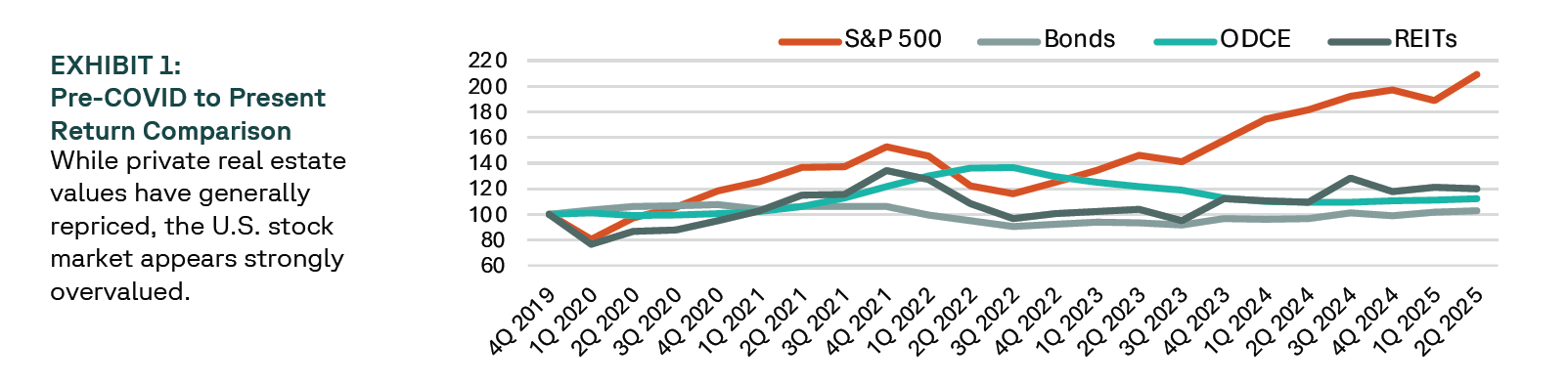
The U.S. stock market was strongly overvalued heading into 2025. The market’s average Price-to-Earnings (P/E) Ratio was significantly above historical averages. While 1Q saw a marginal draw down from tariff news, the equity market roared back in 2Q, further increasing the P/E Ratio and reminding everyone that it’s difficult to time markets successfully.
In this environment, we remain confident that high quality real estate, especially core assets that have already repriced, is at an attractive basis to other asset classes today.
Uncertainty around the Economy, Interest Rates and Inflation
While the data did not yet justify calling a recession at the start of the year, there were signs of a slowing economic outlook as consumer balance sheets were beginning to show increasing strain. Meanwhile, inflation had been slowing significantly from the all-time highs of just a few years ago, but remained stubbornly elevated in recent quarters, hovering above the Federal Reserve’s 2% target and delaying any interest rate cuts. Given this backdrop, market commentators voiced increasing concern that the inflationary environment might persist and prompt the Federal Reserve to keep interest rates higher for longer. Inflation tends to lead to higher replacement costs, largely due to increases in construction budgets. In fact, tariffs on steel and aluminum, which are primary components for real estate developments, recently rose by ~25%.1 If these tariff levels remain in place, they will almost certainly lead to higher project costs and potentially lower profit margins for developers. Thus, in the near term, many new development opportunities may no longer “pencil out” given the higher cost of construction materials. As a result, one would expect there to be less new real estate supply, which should ultimately benefit existing real estate portfolios because in an environment where there is limited new supply, real estate investors have historically been able to sustain healthy rental growth. It is not clear if this will be the case under whichever tariff regime ultimately prevails, but it certainly falls within the realm of potential outcomes.
Market Volatility
While the levels at which tariffs will finally stabilize is still unclear, several shifts in trade policy have not only sparked widespread uncertainty and volatility, but they have also caused many market participants to pause some investment activity. The consensus generally remains that a “wait and see” approach is prudent until there is more clarity regarding the actual implementation and corresponding impact of tariffs.
An Uneven Private Real Estate Market Recovery
At the beginning of the year, private real estate markets were clearly in recovery mode. For starters, valuations had adjusted to reflect current interest rates, and at the time, we had written in our quarterly market commentary that we believed the ODCE index had bottomed. We projected that the rolling 1-year return would turn positive in 1Q 2025 for the first time in two years and continue that positive trend in 2Q.
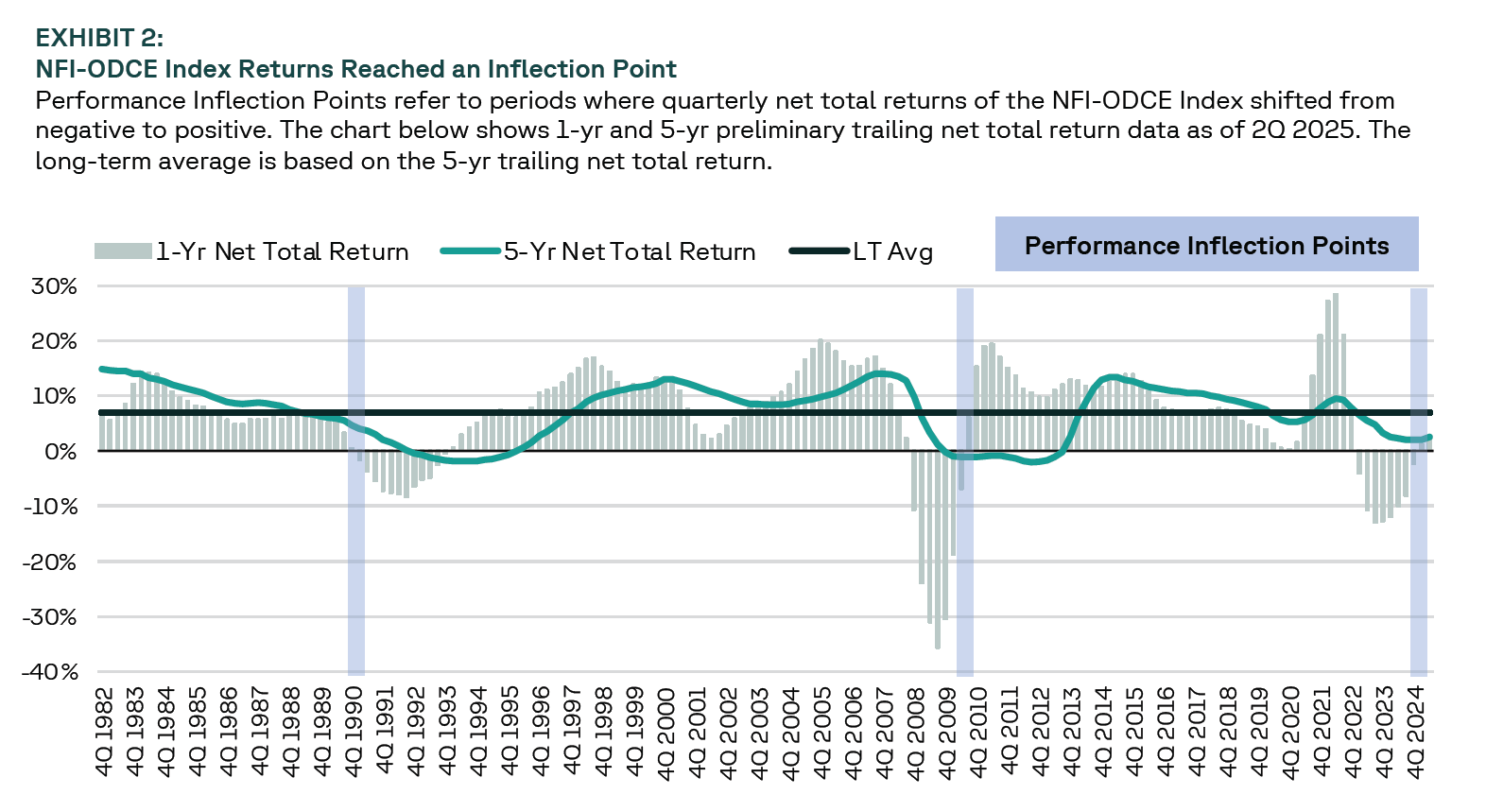
But not all real estate remains positive, especially some specialty sectors such as life science, of which the ODCE index only has 3.4% exposure as of 2Q 2025. While many of these buildings are new or relatively new, their tenants typically lack high quality credit and are dependent on grants or other funding sources that can be pulled at a moment’s notice. At the other end of the spectrum are data centers which continue to outperform thanks to modern designs and some of the highest quality credit tenants in the world.
Re-evaluating Inflation Expectations
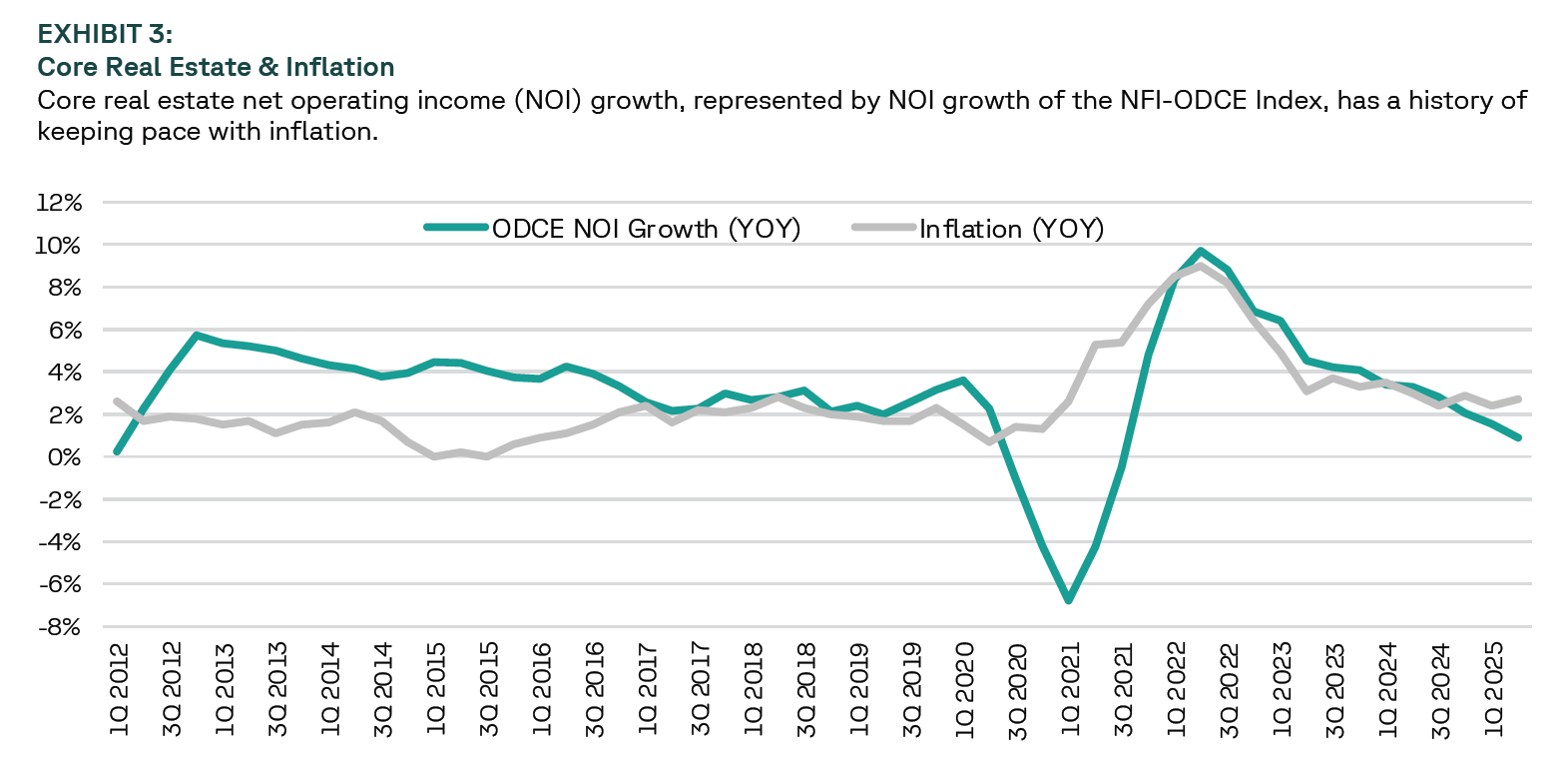
Inflation tends to attract investors to private real estate as a hedge given the asset class’s ability to generate income and appreciate during inflationary periods. While inflation remains stubbornly high, it can impact private real estate returns in a number of ways. For example, it generally leads to an increase in property values as replacement costs rise. At the same time, it can spur rental growth as landlords adjust rents to keep pace with rising costs, which can help maintain or increase cash flow from properties.
Fundamentals Matter
In its simplest form, private real estate is a demand-driven asset class. As long as tenant demand remains intact and supply stays constrained, fundamentals should support continued recovery.
In today's market, the fundamentals are solid, and one could argue they are poised to improve given that the higher construction costs brought about by tariffs and inflation will likely limit new supply from coming online.
Mitigate Asset Allocation Risk and Diversify
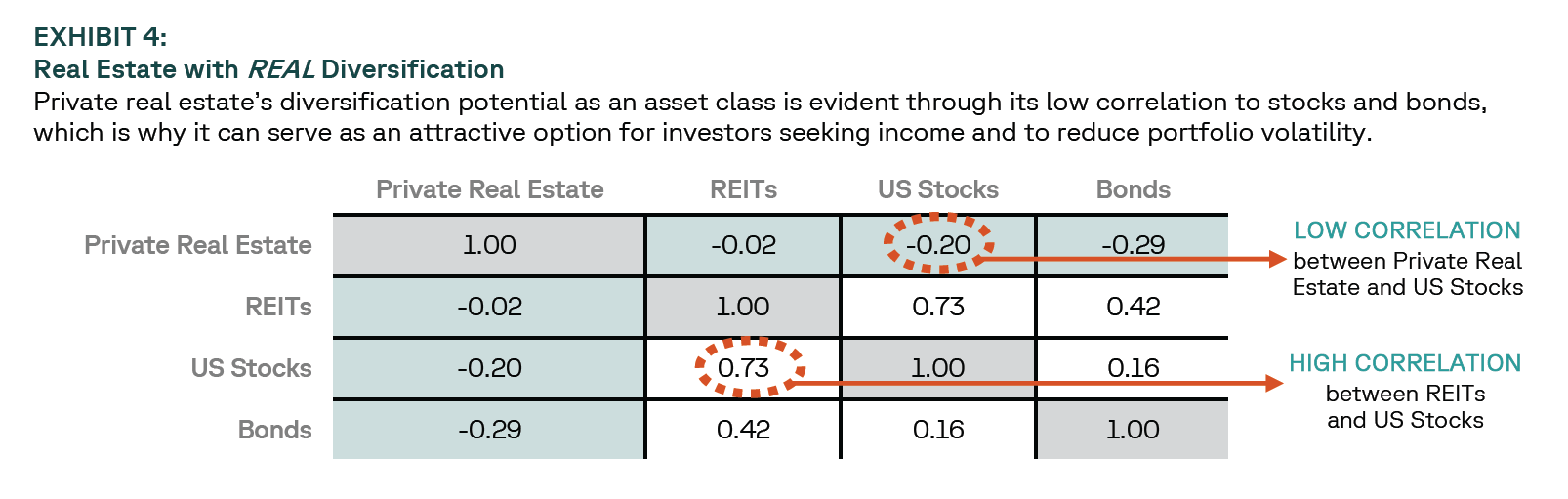
High quality private real estate plays a valuable role in portfolio strategy today. It has several attractive attributes, including its ability to offer a hedge against inflation while also providing portfolio diversification. It has historically exhibited a low correlation to traditional asset classes like public equities and fixed income. In short, when stocks and bonds zig, private real estate tends to zag, providing diversification benefits that reduce overall portfolio risk. Thus, maintaining their customary target asset allocation is crucial for many investors today because it serves as a safeguard during challenging economic conditions. However, as mentioned, the private real estate recovery will continue to be uneven and not all sectors or assets will have the same outcome; therefore, it's also important to diversify the types of private real estate one owns.
 Selectively Seize Opportunity
Understandably, some investors will opt to sit tight in the face of pending market uncertainty, particularly those who are unsure about how to navigate those conditions. Yet, history suggests that uncertainty and volatility tend to create attractive opportunities. Our approach is to be selective as these opportunities emerge, leveraging our private real estate expertise and experience from prior cycles to take advantage of such opportunities as they present themselves.
Conclusion
Looking ahead, there are always risks that investors must navigate as the world around them changes. At Accordant, you will continue to hear the same key themes that drive our focus over the long term.
Private real estate remains one of the most stable sectors during turbulent times. While the public equity markets will always be relatively more prone to volatility, private real estate offers a much-needed diversification tool for investors who recognize the value in tangible, income-generating assets that provide true non-correlated returns to stocks and bonds.
For those who are fully allocated to private real estate, we believe you should feel confident in the sector’s resilience and growth potential. And for those who have not yet optimized their allocations, this may be the moment to reconsider your position. Whether focusing on high quality, core assets, or jumping into newly emerging opportunities that capitalize on investing in assets below replacement cost or the demand for tech-related real estate, we believe there are compelling reasons to act now.
On behalf of our team at Accordant, we want to thank you for your continued trust in these challenging yet promising times. We remain committed to building transparent, high-quality solutions that align with your investment goals.
Garrett Zdolshek
Chief Investment Officer and Portfolio Manager
garrett.zdolshek@accordantinvestments.com
accordantinvestments.com
Sources
EXHIBIT 1: ODCE net total return indexed to 100 (4Q 2019 = 100) as of 2Q 2025. Gross total return indexed to 100 (4Q 2019 = 100) for REITS, S&P 500 & Bonds as of 2Q 2025. Source: IDR, NFI-ODCE Index, S&P 500 Index, NAREIT All Equity REIT Index and Bloomberg Barclays U.S. Aggregate Bond Index.
EXHIBIT 2: 1-Yr & 5-Yr preliminary trailing net total return data as of 2Q 2025. Long-term average based on the 5-Yr trailing net total return. Performance Inflection Points refer to periods where quarterly net total returns of the NFI-ODCE Index shifted from negative to positive. Source: IDR, Component Funds, NFI-ODCE Index (“ODCE”).
EXHIBIT 3: Year-over-year same-store NOI growth for the NFI-ODCE Index as of 2Q 2025. Year-over-year inflation represented by the Consumer Price Index for All Urban Consumers: All Items in U.S. City Average as of 2Q 2025. Source: IDR, NFI-ODCE, U.S. Bureau of Labor Statistics.
EXHIBIT 4: Fifteen-year correlation of total gross returns for all asset classes as of 2Q 2025. Past performance is not indicative of future results. All indices are unmanaged and not directly investable. Source: NFI-ODCE Index (“Private Real Estate”), FTSE Nareit Equity (“REITs”), S&P 500 (“U.S. Stocks”), Bloomberg Barclays U.S. Aggregate Bond Index (“Bonds”).
1 What happened the last time Trump imposed tariffs on steel and aluminum
Important Disclosures
Accordant Investments LLC (“Accordant”) is an SEC registered investment adviser. For more information about our services and disclosures, please visit our website at www.accordantinvestments.com. This content does not constitute an offer to sell, a solicitation of an offer to buy, or a recommendation of any security or any other product or service managed by Accordant.
NCREIF Fund Index – Open End Diversified Core Equity (the “NFI-ODCE Index”). Indexes are unmanaged, do not incur management fees, costs, and expenses, and cannot be invested in directly. Diversification strategies do not ensure a profit and do not protect against losses in declining markets. The selected examples of specific types of investments were selected for illustrative purposes only and are not necessarily representative of all transactions of a given type with regard to performance and/or operating metrics.
Past performance is no guarantee of future results. Therefore, you should not assume that the future performance of any specific investment or investment strategy will be profitable or equal to corresponding past performance levels. Inherent in any investment is the potential for loss. It should not be assumed that any investments in securities, companies, sectors, or markets identified and described in this were or will be profitable.
This content is provided for informational purposes only, and should not be relied upon as legal, business, investment, or tax advice. Furthermore, this content is not directed at nor intended for use by any investors or prospective investors and may not under any circumstances be relied upon when making a decision to invest in any strategy managed by Accordant.
This market update contains forward-looking statements which include statements, express or implied, regarding current expectations, estimates, projections, opinions, and beliefs of Accordant. Such statements are forward-looking in nature and involve a number of known and unknown risks, uncertainties and other factors. Accordant’s opinions may change, and actual results may differ materially from the forward-looking statements.
Certain information contained in here has been obtained from third-party sources. While taken from sources believed to be reliable, Accordant has not independently verified such information and makes no representations about the accuracy of the information or its appropriateness for a given situation. In addition, this content may include third-party advertisements; Accordant has not reviewed such advertisements and does not endorse any advertising content contained therein. Charts and graphs provided within are for informational purposes solely and should not be relied upon when making any investment decision.
No part of this material may be (i) copied, photocopied, or duplicated in any form, by any means, or (ii) redistributed without Accordant’s prior written consent