

EXECUTIVE SUMMARY
- We believe real estate values have bottomed and while the repricing can stir concerns, for value buyers, it can also set the stage for an attractive entry point.
- Operating fundamentals remain strong and with limited new supply in the pipeline, we expect operating income growth to remain robust
- Asset allocation is driving new inflows, Institutional investors are beginning the rebalance to private real estate given the revaluation and equity markets at all time highs
- The “new economy” 2.0 is driving the need for data storage, computing capacity and power at unprecendented levels, creating a clear path for data center demand and rental rate growth
Dear Valued Clients,
As we enter the fourth quarter, we are reminded that challenging times in the market often create the most compelling opportunities. In our view, now is the time to consider increasing exposure to private real estate. A look at the NFI-ODCE Index shows that core real estate values have declined by nearly 25% from their peak, creating an opportunity to acquire high-quality assets at compelling prices. While a value drop of this magnitude can stir concerns, it’s a rarity that occurs on average only once every 14 years and can set the stage for potentially rewarding investments.1
As a continuation of the remarks in our prior commentary, there is increasing evidence that capital is continuing to return to the sector. We are seeing a marked uptick in transaction activity and a narrowing of the bid-ask gap between buyers and sellers. With this, institutional investors are beginning to act—many are early movers, recognizing the inherent value in current market conditions. Those under-allocated to real estate should take note, especially those seeking to bolster portfolios with diversified, non-correlated assets.
From a macro perspective, we see broad market dynamics shifting in favor of the private real estate market. Here’s why we believe the right moment to act is now:
A More Favorable Credit Environment
The easing of inflationary pressures and the beginning of interest rate moderation have set the stage for a more favorable lending environment. Credit is becoming cheaper and more abundant with large pools of capital providers looking to lend, creating healthy competition that benefits borrowers. As borrowing costs ease, equity capital can continue to reenter the market and further help to close the already shrinking valuation gap between buyers and sellers. While credit has outperformed equity over the past two years, we believe the credit markets are flush with capital and now is the time for equity in the next part of the cycle.
Equity Markets and Asset Allocation Rebalancing
Public REITs have performed strongly in recent months and the S&P is at or near record highs. This increases the capacity for asset allocations that are again underweight in private real estate (the denominator effect). Private real estate has clearly provided a non-correlated return in a diversified portfolio. Historically, this has often been a leading indicator that private real estate will see inflows. We believe it’s time for those asset allocators to begin the transition from equity overweights to private real estate which offers a compelling valuation.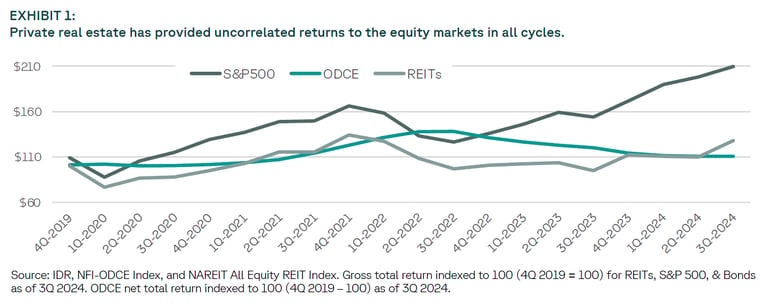
A Limited Development Pipeline
The high construction costs and rising interest rates of the past few years have led to a slowdown in new development. These factors have made meeting profitability expectations with new development projects harder today than they have been in more than a decade.4 As a result, the prospective supply growth across many real estate sectors is expected to decline, which can create a tailwind for rent growth and occupancy rates in existing properties.
A notable exception to this trend is the development of new data centers, which is anticipated to continue as expected profit margins for these assets have remained rather high over the last several years, and don’t show signs of letting up due to significant and growing demand. If anything, a slowdown in development for this sector would likely be due to increasing resource constraints related to land or power, rather than a decrease in demand.
Continued NOI Growth
Despite concerns in some areas, many private real estate sectors continue to exhibit strong operating fundamentals. Cash flows are robust, even in line with prior cycle peaks, despite the headlines.5 Furthermore, recent economic data shows hiring surged in September. National employment remains healthy as unemployment ticked downwards, and many regions are experiencing job growth. This supports the long-term NOI growth potential of real estate. With fewer new developments in the pipeline, existing assets stand to benefit even more from favorable supply-demand dynamics.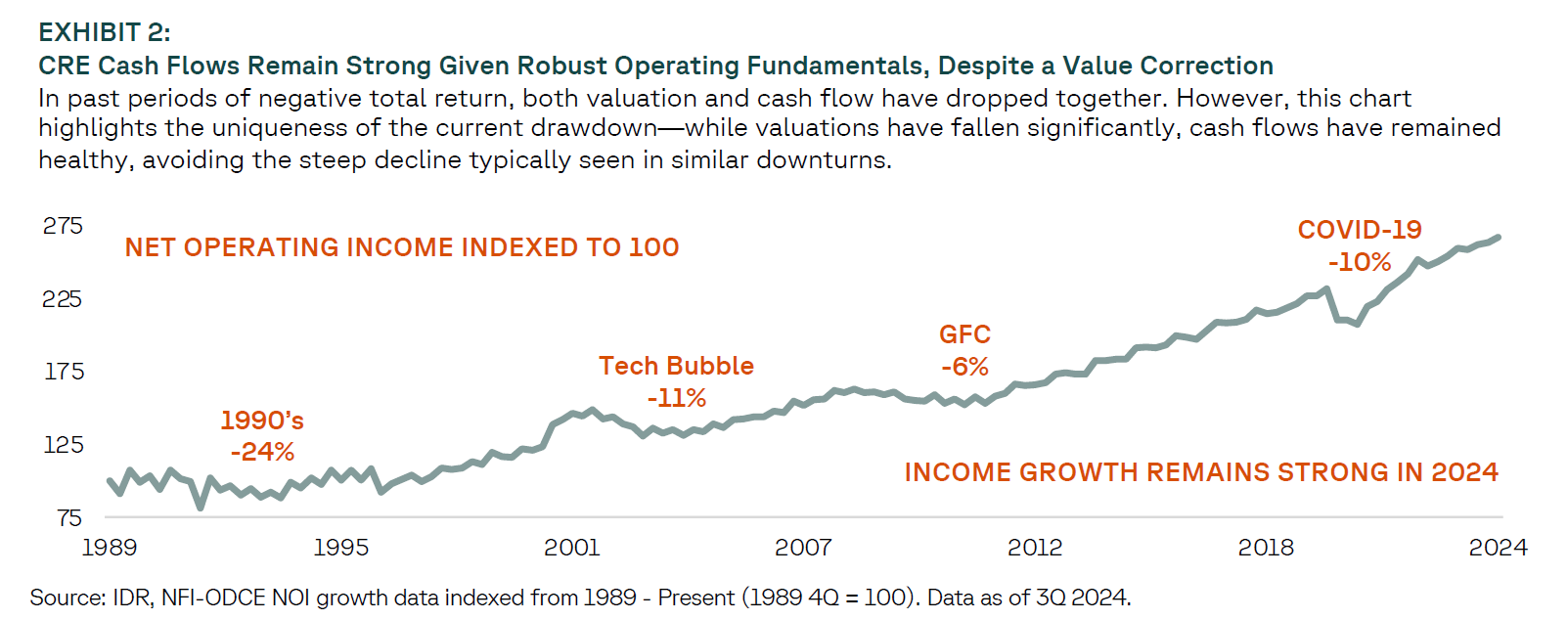
Limited Distress, but Targeted Opportunities
While widespread distress is unlikely given the improving macroenvironment and strong operating fundamentals (with the exception of office assets), there are isolated instances of owners needing to sell due to over-leveraging or poor capital structures. After reaching a three-decade low in Q3 2022, commercial real estate delinquencies on bank loans have been steadily climbing.4 This can create strategic acquisition opportunities at a discount. Those who can identify these opportunities stand to benefit from significant upside as market conditions improve.
As the broader market dynamics continue to shift, we see significant opportunity across several key areas of private real estate:
Apartments and Industrial Assets Below Replacement Cost
Some of the most attractive prospects lie in sectors where properties can be acquired below replacement cost. These types of discounts are rare, generally occurring only after substantial market revaluations, and are unlikely to last as construction costs stabilize and demand picks up. High-quality apartment and industrial properties are now being offered at prices below what it would cost to build them today. In certain regions, the tight supply and steady demand will further enhance the potential for value appreciation.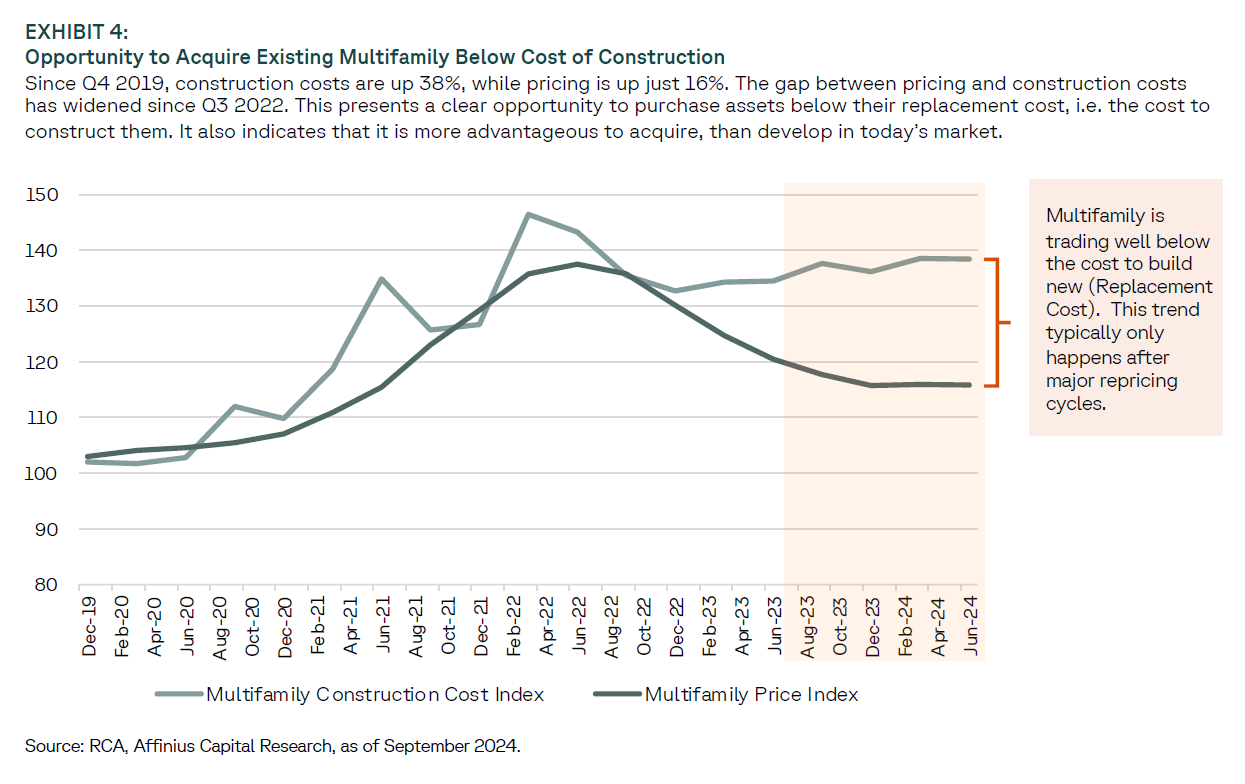
Data Center Development
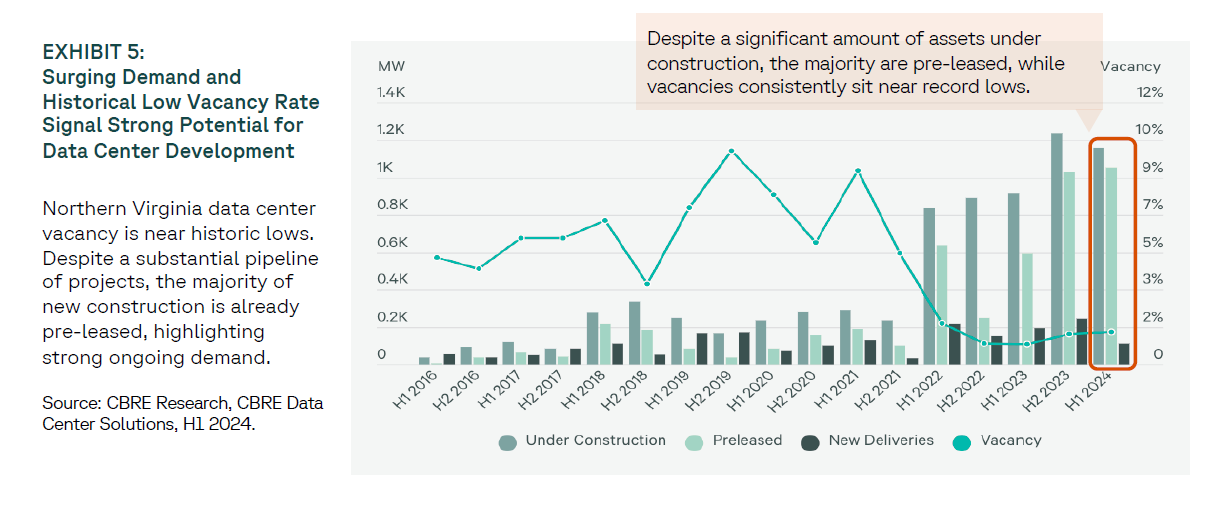
The surge in demand for cloud computing, storage, and processing power has created an unprecedented need for new data center construction. Expected profit margins for development projects, which have been high over the past few years, should remain healthy. Hyperscalers like Amazon, Microsoft, and Google are aggressively seeking locations with adequate power, capacity, and infrastructure to meet their needs, making this, in our opinion, one of the most attractive property types for development, today. The supply-demand imbalance in major markets—such as Northern Virginia, where vacancy rates are at historic lows—presents a window for developers who can meet these exacting criteria.6
Private real estate remains one of the most stable sectors during turbulent times. While the public equity markets continue to fluctuate, private real estate offers a much-needed diversification tool for investors who recognize the value in tangible, income-generating assets.
For those who are fully allocated to private real estate, we believe you should feel confident in the sector’s resilience and growth potential. And for those who have not yet optimized their allocations, this may be the moment to reconsider your position. Whether focusing on high quality, core assets, or jumping into newly presented opportunities that capitalize on assets below replacement cost or the demand for tech-related real estate, there are compelling reasons to act now.
On behalf of our team at Accordant, we want to thank you for your continued trust in these challenging yet promising times. We remain committed to building transparent, high-quality solutions that align with your investment goals.
Garrett Zdolshek
Chief Investment Officer and Portfolio Manager
garrett.zdolshek@accordantinvestments.com
accordantinvestments.com
Notes
1 IDR
2 Is Development Still Financeable? That Depends. | Commercial Property Executive
3 Three reasons we see a potential comeback in commercial real estate | J.P. Morgan Private Bank
4 North America Data Center Trends H1 2024: Northern Virginia | CBRE
Important Disclosures
Accordant Investments LLC (“Accordant”) is an SEC registered investment adviser. For more information about our services and disclosures, please visit our website at www.accordantinvestments.com. This content does not constitute an offer to sell, a solicitation of an offer to buy, or a recommendation of any security or any other product or service managed by Accordant.
NCREIF Fund Index – Open End Diversified Core Equity (the “NFI-ODCE Index”). Indexes are unmanaged, do not incur management fees, costs, and expenses, and cannot be invested in directly. Diversification strategies do not ensure a profit and do not protect against losses in declining markets. The selected examples of specific types of investments were selected for illustrative purposes only and are not necessarily representative of all transactions of a given type with regard to performance and/or operating metrics.
Past performance is no guarantee of future results. Therefore, you should not assume that the future performance of any specific investment or investment strategy will be profitable or equal to corresponding past performance levels. Inherent in any investment is the potential for loss. It should not be assumed that any investments in securities, companies, sectors, or markets identified and described in this were or will be profitable.
This content is provided for informational purposes only, and should not be relied upon as legal, business, investment, or tax advice. Furthermore, this content is not directed at nor intended for use by any investors or prospective investors and may not under any circumstances be relied upon when making a decision to invest in any strategy managed by Accordant.
This market update contains forward-looking statements which include statements, express or implied, regarding current expectations, estimates, projections, opinions, and beliefs of Accordant. Such statements are forward-looking in nature and involve a number of known and unknown risks, uncertainties and other factors. Accordant’s opinions may change, and actual results may differ materially from the forward-looking statements.
Certain information contained in here has been obtained from third-party sources. While taken from sources believed to be reliable, Accordant has not independently verified such information and makes no representations about the accuracy of the information or its appropriateness for a given situation. In addition, this content may include third-party advertisements; Accordant has not reviewed such advertisements and does not endorse any advertising content contained therein. Charts and graphs provided within are for informational purposes solely and should not be relied upon when making any investment decision.
No part of this material may be (i) copied, photocopied, or duplicated in any form, by any means, or (ii) redistributed without Accordant’s prior written consent.